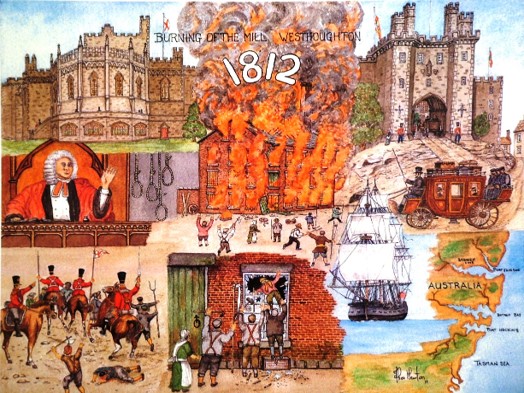
Summary of Burning of the Mill at the Factory Nook, Westhoughton in 1812.
Garth Ratcliffe
The livelihoods of home weavers of cotton, wool and silk were being threatened by the development of weaving machines in English factories. Clearly the home workers could see that factory production would be delivered by unskilled labour cheaper than home weavers and even child labour could be used.
The Luddite movement was a reaction to this threat and started in Nottinghamshire and Derbyshire where silk stockings were produced and featured workers smashing looms and burning down factories.
The Luddite movement spread to Yorkshire because of threats to the woollen industry and eventually to the Lancashire cotton industry.
Several factories in the Oldham, Stockport and Manchester areas had been burned down and the owners and their homes attacked.
Hence developers decided to build a factory in 1804 at Westhoughton away from centres of riots and unrest.
- King George III and his court were petrified that the equivalent of a French revolution would start in England hence laws were passed making illegal the holding of meetings between men or workers and this is where the story becomes more local.
- Bolton Luddites held meetings at night, in the dark, on Bolton Moor and Deane Moor ( both between Westhoughton and Bolton) in order to make plans to burn down Westhoughton Factory because this was, for the time, a large factory of advanced looms. But George III relied on a network of paid spies to infiltrate Luddite groups and identify people who had taken an illegal oath or simply been present when an illegal oath was administered!
- In the first instance, these spies reported to Colonel Ralph Fletcher who was leader of the local militia, Bolton Light Horse Militia, and William Hulton who was also a magistrate. (Both of these magistrates were subsequently involved with the Peterloo massacre). There were no police forces at the time rather law and order was maintained by deploying cavalry at likely trouble spots so the Scots Greys were stationed at Bolton.
- In fact the more militant Luddites were located at Chowbent (Atherton) an area that was known for radicalism.
- On the Friday 24th April, the Scots Greys rode to the Westhoughton Factory after noon because they had been tipped off that the factory was scheduled to be attacked. However no Luddites turned up, rather they waited until the militia had returned to Bolton and then marched from Chowbent to the factory. The factory was locked up but entry was gained by lifting a boy Abraham Charleson through a small window and he then opened the door for the Luddites to enter and break/smash looms and set fire to the building using straw from the stables at the White Lion opposite and coals from a cottage at the bottom of factory nook.
- On returning to Chowbent, the Luddites also burned down Westhoughton Hall, the home of the Lockett family who had built the factory. The factory proprieters, Wroe and Duncough, rented the facility from the Locketts.
- By the time that the militia had returned from Bolton, having been called out by the foreman of the factory, the factory had burned down. The militia had been made fools of.
- Next day the militia, under the orders of Ralph Fletcher, arrested numerous men and several women at Chowbent on suspicion of being involved with burning the factory or illegal oath taking. They were taken by horse and cart to Lancaster Castle/jail where they were tried for the offence of breaking looms and burning a factory, and this was a capital offence. Others were charged with administering or taking an illegal oath and the punishment for this offence was transportation to Australia for 7 years.
- The trial resulted in 4 men, including the boy aged 14, being found guilty of loom breaking and were all publicly hanged at the castle (in the hanging corner) and 9 other men were found guilty of the lesser offence and transported.
At Lancaster Castle there is still in existence the cells that the men were detained in and the original courtroom where the trial was held. The “jury” were all landowners and business people. I have copies of all the trial papers. Surprisingly these were not kangaroo courts. It was necessary for the prosecution to specify the charges and present the evidence, usually from witnesses. Naturally the defendants had no witnesses to support their case and hence struggled to prove their innocence.
The transported convicts were taken down to Portsmouth to join the ship Fortune and sailed to Australia, a journey of 8 months or so.
On arriving at Sydney, the convicts were either put to construction work building roads or docks and some were allocated to wealthy landowners as farm labourers.
When the 7 year sentence was served, convicts could return to England by either paying for their passage or by working their passage. Some convicts who had worked well and had the approval of their master could be released early and others were even given land to develop.
Research has attempted to establish what happened to these men who were transported to Australia but the results are not conclusive.
For more details of this event see http://www.westhoughtonlocalhistorypresentationsandphotos.com
Click on PRESENTATIONS, then TIMELINE OF MAJOR EVENTS followed by a click on Burning of Westhoughton Mill by Luddites in 1812.
 Westhoughton Local history